
Blue Tears — Kuala Selangor
Blue tears are Noctiluca scintillans plankton: seasonal, conditional and never guaranteed. What triggers the glow and the conditions that make it likely.
Updated · 5 min read
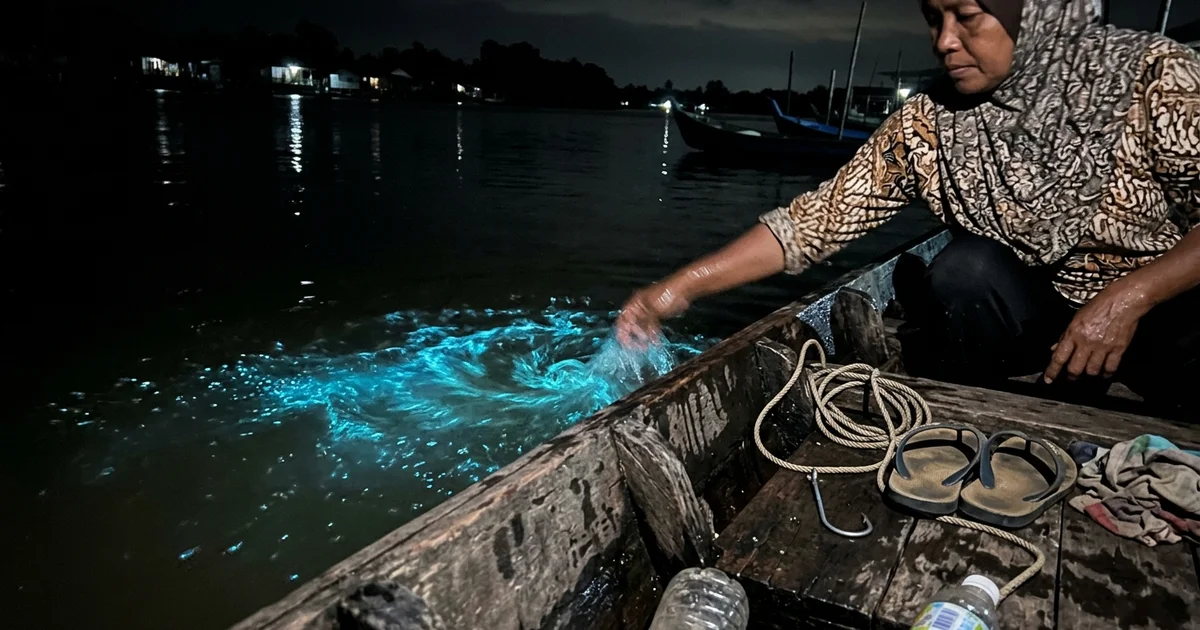
What blue tears actually are
Blue tears are the second thing people hope to see on a Kuala Selangor fireflies evening, and the one that is hardest to promise. They are not a light show that someone switches on. They are a living organism: Noctiluca scintillans, a single-celled bioluminescent plankton, sometimes called sea sparkle. When the water around them is agitated, each cell releases a short blue-green flash. Millions of them together turn a paddle stroke, a boat wake or a trailing hand into a brief line of cold light.
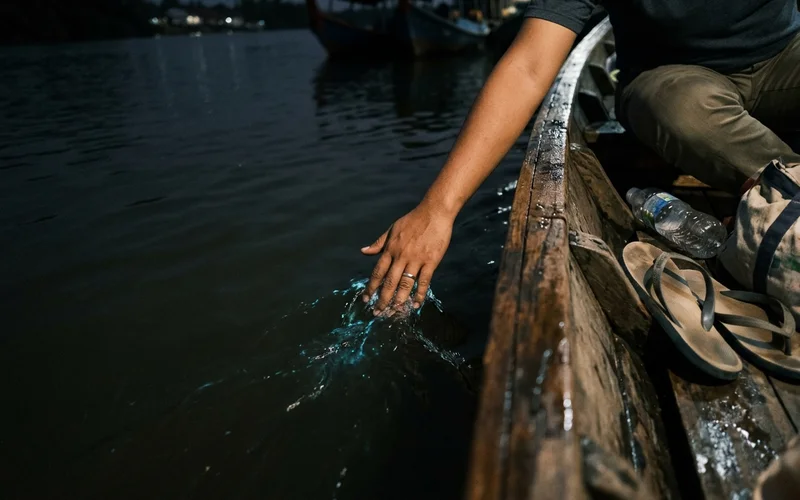
That mechanism matters, because it explains everything else about seeing them. The glow is a stress response to movement, not a steady background shine. Still water shows nothing. Disturbed water lights up for a second or two and then goes dark again. On the evening we run our fireflies and blue tears tour, the boatman may run a hand or an oar through the water to show you exactly this.
Why we will not promise them
The photographs you have probably seen of blue tears are, more often than not, long exposures. A camera left open for fifteen or thirty seconds gathers light your eye never receives in one moment. The real thing is subtler: a soft blue shimmer where the water breaks, closer to a faint glow than to the electric-blue waves in a travel advertisement.
We say this in advance for a practical reason. Overselling certainty is the single biggest cause of disappointment in this category. If you arrive expecting the photograph, an honest, decent night on the river will feel like a letdown. If you arrive expecting a natural phenomenon that may or may not perform, a good night feels like what it is, which is lucky.
Our position, in one line
We promise the evening: the pickup, the fort, the dinner, the boat and a licensed guide. We do not promise what the water will do.
What makes a bloom
Blue tears need a population of Noctiluca in the water in the first place. That population rises and falls with water temperature, salinity where the river meets the sea, nutrient levels and recent rainfall. Those factors move on a scale of weeks, not hours, which is why blue tears are described as seasonal rather than nightly.
Heavy rain upstream works against you twice over. It dilutes the brackish water the plankton favour and it pushes sediment down the river, so even an existing bloom is masked by murk. A run of dry evenings is a better sign than any calendar date.
The conditions that help
Four things stack in your favour, and they are the same four that favour the fireflies.
Darkness. A new-moon phase. Any strong moonlight raises the ambient light above the level of the glow, and the glow simply disappears against it.
Dry weather. No heavy rain in the days before, and none on the night.
Timing. Roughly 8 to 10 PM, once the sky is genuinely dark, not merely dim.
Adjusted eyes. Give yourself ten minutes on the water without looking at a phone. A single bright screen resets everyone’s night vision, yours included. This is the most common reason people miss a display that was actually there.
Because these overlap so neatly with firefly conditions, planning around one plans around the other. The best time to visit sets out how to read the moon phase against your travel dates.
Where on the route you might see them
The blue tears appear in the brackish stretch of the Selangor River, on the same evening cruise as the fireflies rather than on a separate trip. Your guide will point out where the boat’s movement is disturbing water, since that is where any glow will show. The unlit, engine-free sampans at Kampung Kuantan give you the darkest water of the two jetties, which helps if a bloom is present.
Bring a light jacket, expect mosquitoes, and keep your torch off. If there is a bloom, the difference between seeing it and missing it is often nothing more than whether the boat gave its passengers ten quiet minutes in real darkness.
Questions people ask
Are blue tears guaranteed on the tour?
No. Blue tears depend on a plankton bloom and on the right water and light conditions on the night. They are seasonal and they are never guaranteed. Any operator promising them is promising something no one can control.
What are blue tears made of?
They are Noctiluca scintillans, a single-celled bioluminescent plankton sometimes called sea sparkle. When the water around them is disturbed, they release a brief blue-green flash.
When are blue tears most likely?
On a dark, new-moon phase, on a dry evening, roughly between 8 and 10 PM. Those are the same low-light conditions that favour the fireflies, which is why one trip can show you both.
Still deciding?
Message us and we'll tell you honestly what the river is likely to look like on your dates.
WhatsApp usRelated guides
-
Bukit Melawati
Bukit Melawati: historic Fort Altingsburg, the Altingsburg Lighthouse and the silver leaf monkeys, the daytime waypoint included in both firefly tours.
-
Firefly Park Resort (Bukit Belimbing)
Bukit Belimbing's covered electric boats: easier boarding, family-friendly, and where the shared tour cruises. Honest pros, cons and who it suits.
-
Kampung Kuantan Firefly Park
What to expect at Kampung Kuantan: quiet non-motorised sampans, berembang trees, no flash photography, and who the traditional river suits best.
-
Tickets & Prices — Kuala Selangor Fireflies
One page for every firefly cost: independent boat tickets at both parks, and both tour prices for the private and shared evening tours.